
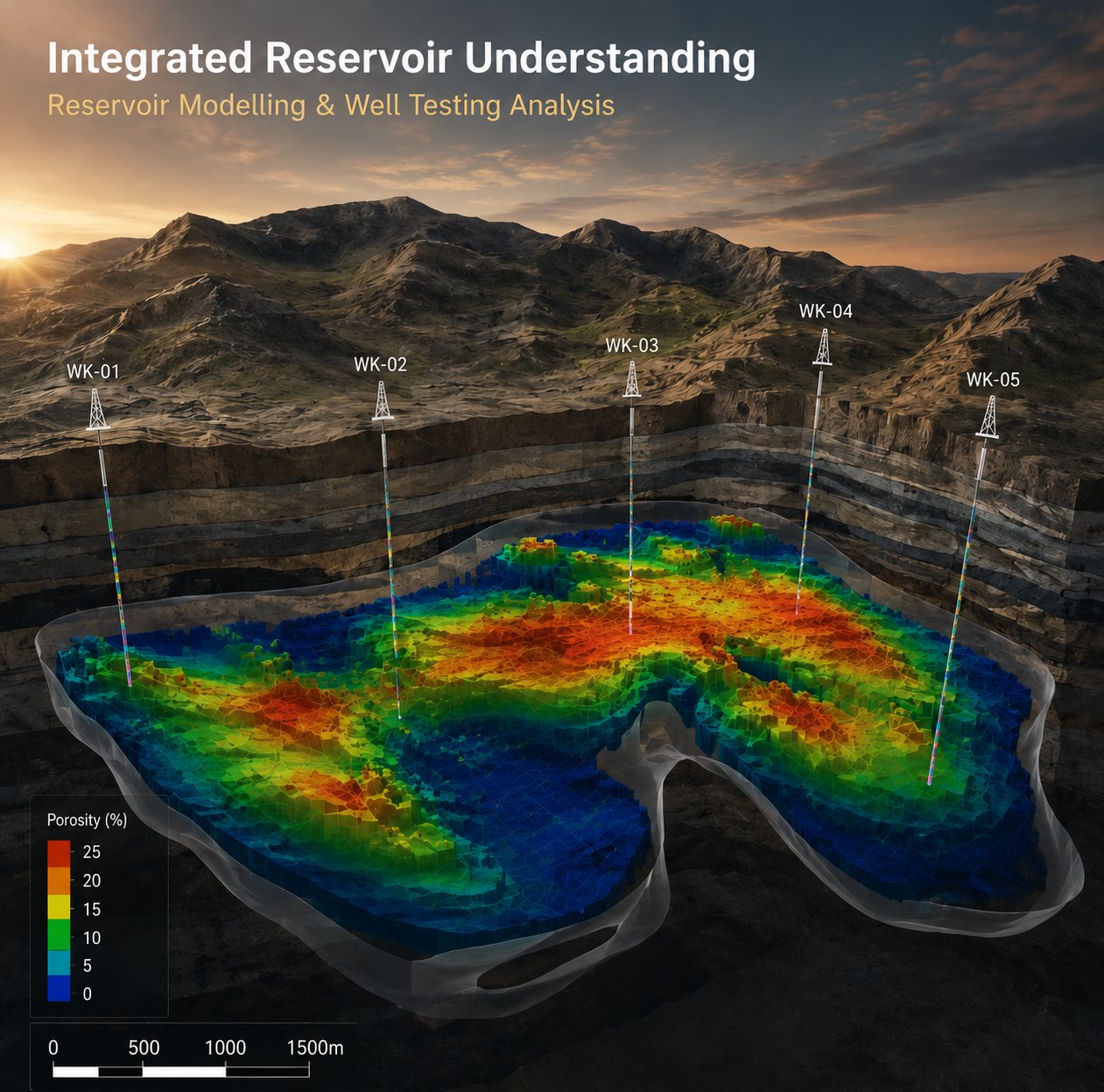
Oil & Gas
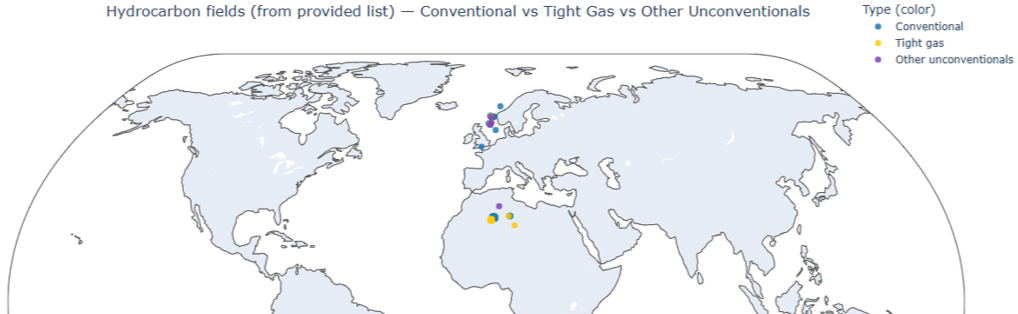
Confidential (Unconventional fields)
Field Development (Norwegian Continental Shelf)
Two neighboring fields producing from sandstones, hydraulically connected through an active, complex aquifer network. The fluid is a slightly heavy oil in the low-20s API range and the development faced multiple sources of subsurface uncertainty.
We applied an uncertainty workflow to quantify ranges of Production Index (PI) for single and highly deviated/complex wells, providing decision-ready envelopes to support well design and planning. This enabled a rapid progression from a “from-scratch” reservoir model to development decisions and execution up to the first drilling campaign, while explicitly accounting for aquifer-driven inter-field communication and key performance uncertainties.
Confidential (Unconventional field)
HPHT Compartmentalized Field (Norwegian Continental Shelf)
HPHT development in a highly compartmentalized reservoir where performance and well placement depended on reliably assessing proximity to sealing faults. Traditional deterministic approaches couldn’t provide a robust estimate of distance-to-seal under structural and interpretation uncertainty.
We applied our methodology to generate safe, decision-ready distance-to-sealing-fault estimates with reasonable uncertainty margins, enabling risk-based well planning and development decisions while accounting for compartmentalization and fault-seal uncertainty.
Confidential (Unconventional fields)
Tight-Gas Fields (MENA)
Portfolio study across four tight-gas fields producing retrograde gas, where predicting well deliverability was the key development question. Rather than defaulting to expensive 2D/3D geophysics campaigns that ultimately added little actionable insight into productivity, I focused on extracting maximum value from existing subsurface evidence.
We led a meticulous re-interpretation of legacy well tests, including DSTs, with a strong emphasis on test quality and operational context. Special care was taken to compare gauge types and data fidelity, reconcile older well-test practices versus more modern procedures, and account for operational factors that bias results—such as bentonite type and resting (shut-in) durations prior to testing.
This detail-driven workflow produced decision-ready productivity estimates (with uncertainty bounds) at a fraction of the cost and time, enabling more defensible planning than additional seismic acquisition that did not translate into deliverability understanding.
Generic Uncertainty Ranges from Historical Well Tests
Cross-field study leveraging numerous wells from Maureen (UK North Sea) and Wytch Farm to establish generic, reusable uncertainty ranges for key oil well-test (formation testing) interpretation outputs. The goal was to move beyond single “best-estimate” numbers and provide decision-ready uncertainty envelopes that reflect real-world data quality and interpretation variability across a broad well population.
By systematically reviewing historical well-test analyses across many wells and normalizing the interpretation framework, the work produced benchmark uncertainty ranges applicable to formation-test deliverables (e.g., productivity-related outputs and interpreted reservoir parameters), improving consistency and risk awareness for screening, planning, and comparison across assets—while keeping the approach generic and non–asset-sensitive.
Maureen (UK North Sea)
& Wytch Farm
(Conventional fields)
Confidential (Conventional fields)
Operations (Norwegian Continental Shelf & Danish North Sea)
16 fields producing from sandstone with Oil/Gas/Retrogrde Gas content, hydraulically connected through another active complex aquifer network.WAG and Gas injection or Water injection often involved.
Uncertainty workflow were used to quantify ranges of determining Pressure Prognosis as well as the Pressure Windows, and in certain cases Production Index (PI) for horizontal and deviated wells.
Hydrogeology
Aquifer Testing
Pumping Test (Martinique island , France)
Dataset: Aquifer Testing
Case Study File to download: Application of MonteCarloFlow software to Aquifer Testing
Safor Well, Martinique, France
Geothermal
Olkaria Well 501 (Kenya)
Publication & Dataset: Geothermal Well Testing
Case Study File to download: Application of MonteCarloFlow software to Geothermal Well Testing
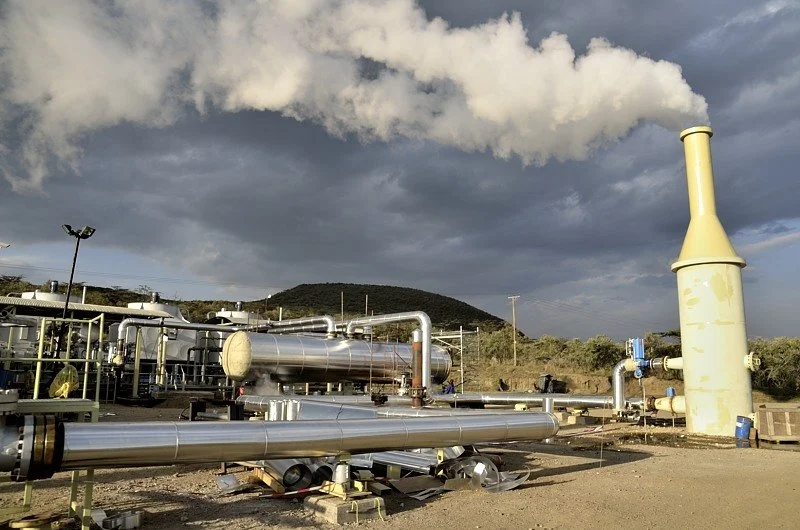
Olkaria Well 501 (Kenya)